Research & publications

Knowledge
that starts
from everyday life.

Six research clusters, findings shared along with their limits, and scientific works you can trace back to the source.

Six research clustersConceptual visualization

The Moonshot Project

Every step sets out from a moonshot.

A moonshot is a big aspiration that sets the direction for Anvesana's research and development projects. Every project starts from a research question, grows into findings, and is then translated into results that can be used and shared.

  1. Starting pointReal life
  2. 01Research questionsQuestions born in the field.
  3. 02Research findingsFindings that are tested and shared together with their limits.
  4. 03ProductInstruments and tools that grow out of the findings.
  5. 04ModulesPrograms and modules that can be put into practice.
  6. MoonshotA great ambition

Moonshot · Indies Lab

NADI Kerja

  • Navigation
  • Assessment
  • Design
  • Intervention

How can people be healthy and successful at work at the same time?

An applied research agenda to help organizations identify potential and pressure, improve their systems, and strengthen their people, so that they are healthy and successful at work.

People · Work systems · Psychosocial health

What we measurePersonality traitsWork stressBurnoutPsychosocial hazardsWell-beingCognition & work attitudes
01Mental health at work

Employee wellbeing is falling. What needs fixing: the people, or their workload and pressure?

Personality does not lower wellbeing directly.

The path runs through work stress and burnout, and both can be changed. Organizations can hardly change personality tendencies; work stress and burnout are the points of intervention.

  1. Neuroticism
  2. Work stress
  3. Burnout
  4. Low wellbeing

Raise wellbeing by fixing workload and pressure, not by selecting for personality.
02Mental health at work

When a leader is exhausted, who else carries the load?

Burnout can spread down the chain of command.

A leader's burnout does not stop with the leader. Pressure is passed on through everyday leadership, then through how workloads and targets are distributed, until frontline teams absorb the accumulation from the two layers above them.

  1. Leaders
  2. Line managers
  3. Frontline teams

Basis of the finding: school principals, teachers, and education support staff (education sector).

A leader's mental health is not a private matter; the cost is borne by the team below.

03Mental health at work

Does burnout in your team look more like exhaustion, cynicism, or feeling stuck?

Three forms of burnout, three different root causes.

A total burnout score hides these differences: units with the same score may need different interventions.

Emotional exhaustiontriggered by
  • Excessive workload
  • Conflict & harassment
Cynicism toward worktriggered by
  • Poor relationships between colleagues
  • Emotional exhaustion left unaddressed
Low personal accomplishmenttriggered by
  • Low role clarity
  • Insufficient support at work
  • Limited opportunities to grow

Read burnout by dimension before choosing a program. One training package does not answer three problems.

04Success at work

Do “top employees” share the same profile in every position?

There is no single winning profile for every position.

The cognitive abilities and personality traits that set top performers apart from the baseline differ from one position to another.

Basis of the finding: a study at a mining services company.

Build a success profile for each position, not one standard for the whole organization.

Our next search

These four findings are only a first step. Next, we are mapping what makes people healthy and successful at work at the same time, and retesting these patterns across sectors.

Bring a question from your organization
3 studies in progress under NADI Kerja

Moonshot · Research consortium

Daya Tumbuh Akademik

Understanding the factors that help students persist, adapt, and grow throughout their studies.

A research umbrella for understanding the factors and dynamics that help students persist, adapt, and keep growing through each level of education. The research is developed in stages: mapping factors, relationships between variables, and finally testing interventions.

Successful education is more than academic achievement. Students face academic demands, adjustment to a new environment, choices of field of study, changes in their psychological state, and social and institutional factors.

Daya (strength)

The capacity to endure, maintain functioning, and draw on resources when facing pressure.

Tumbuh (growth)

The capacity to move beyond mere survival toward adaptation and development.

Akademik (academic)

The context where that capacity shows: adaptation, continuation of studies, and academic performance.

Individual factorsCurrent psychological stateIndividual characteristicsEnvironmental factorsSocial factorsInstitutional factors
Daya Tumbuh
Akademik
Students' capacity to persist, adapt, and grow during their studies
OutcomesAcademic performanceHealth and self-actualization

Early research findings

Academic performance and adaptation
cannot be understood through a single factor.

Study 1 · Academic performance434 polytechnic students23.1% → 37.6%

Cognitive ability explained 23.1% of the variation in academic achievement. Analyzed together with work aptitude, interests, mechanical ability, and learning styles, the explained variation rose to 37.6%.

Cognitive ability matters, but it is not enough to understand students' academic achievement.

Study 2 · Academic adjustment134 students34%

Mental toughness and neuroticism together explained 34% of the variation in college adjustment. The relationship between mental toughness and college adjustment differed at different levels of neuroticism.

Mental toughness does not work separately from underlying emotional stability.

Study 3 · Students in the wrong major477 studentsProtective & risk

Protective factor: the fit between students' interests and the major they chose. Risk factors: a lack of information about majors and campuses, a lack of preparation for entrance tests, and failure to meet the passing grade.

It is important to understand what happens before students enter higher education.

These findings are a starting point, not a final conclusion. The initial research used study designs in particular contexts and samples; the associations cannot yet be used to draw general conclusions about cause and effect. The model will keep developing together with partners.

Forms of collaboration

Research

Developing methods with the expert team, instruments, data analysis, and participant recruitment, fieldwork, and research ethics.

Program development

Pilot interventions once the evidence is sufficient, along with recommendations, modules, and facilitator training.

CollaboratorsPerguruan tinggiSekolahDosen & penelitiGuru & praktisi pendidikanPsikolog

Ethics and data protection

  • Voluntary participationStudents may end their participation through the agreed mechanism.
  • Separate from academic decisionsResults are not used for academic or administrative decisions.
  • Clear consentThe assessment and consent to data use are explained separately.
  • ConfidentialityIndividual information is shared only through the agreed mechanism.
  • Institutional controlData remain under the control of the home institution and are managed in Indonesia.
  • No rankingThere is no public ranking of universities.
5 studies in progress under Daya Tumbuh Akademik

Join the journey

Moonshots are reached together.

Universities, schools, organizations, researchers, and practitioners can help frame the questions, carry out the research, and test the programs.

Discuss a collaboration

From question to publication

  1. Stage 1Ongoing researchWork in progress. No results shared yet.
  2. Stage 2The FindingsEarly findings shared, limits included. Not yet published in a journal.
  3. Stage 3PublicationsPresented or published, and citable.

Stage 1 Ongoing research

What we are exploring.

The questions the Anvesana team is working on with its partners, and how far each has come. Interim results are shared only after review.

NADI Kerja

How can people be healthy and successful at work at the same time?

Meet this moonshot

Workplace

How is personality related to burnout among teachers?

Path Analysis of Teacher Burnout and Personality

  1. Design
  2. Data collection
  3. Analysis
  4. Manuscript writing (current stage)
  5. Journal review

Manuscript writing · Analysis is complete and has been reported to the partner; a manuscript for an international journal is being written.

Team
Rafli Sodiq Bagaskara, Lucia Trisni W.
Partner
A provincial education office

Workplace

How resilient are employees in the face of work pressure?

Workforce Resilience Map

  1. Design
  2. Data collection
  3. Analysis (current stage)
  4. Manuscript writing
  5. Journal review

Analysis · A resilience model is being developed from burnout and personality data.

Team
Lucia Trisni W., Rafli Sodiq Bagaskara, Anjar Kartaputra

Workplace

Does burnout spread within a school?

Within-School Clustering and Crossover of Burnout Among Principals, Teachers, and Educational Support Staff

  1. Design
  2. Data collection
  3. Analysis
  4. Manuscript writing (current stage)
  5. Journal review

Manuscript writing · The manuscript is nearly final and has not yet been submitted to a journal.

Team
Rafli Sodiq Bagaskara
Partner
A provincial education office

Daya Tumbuh Akademik

What helps students persist, adapt, and grow throughout their studies?

Meet this moonshot

Career & education

Why do so many university students feel they are in the wrong major?

Examining Determinant Factors of Wrong Major Phenomenon

  1. Design
  2. Data collection
  3. Analysis
  4. Manuscript writing
  5. Journal review (current stage)

Journal review · Reviewer revisions have been submitted; awaiting publication.

Team
Rafli Sodiq Bagaskara, Anisa Rima Fadhilah, Fathina Azizah, Athar Rosyad Partadireja, Teddy Indira Budiwan

Career & education

Beyond IQ, what else shapes the achievement of vocational students?

Incremental Validity of Vocational Interests, Learning Styles, and Aptitudes Beyond Intelligence for Predicting Academic Performance

  1. Design
  2. Data collection
  3. Analysis
  4. Manuscript writing (current stage)
  5. Journal review

Manuscript writing · The full manuscript is ready to be submitted to a journal.

Team
Tim Indies Lab Anvesana
Partner
A vocational polytechnic in engineering

Career & education

What makes senior high school students confident in choosing a university major?

Path Model for Career Maturity: The Transition from Senior High School to Higher Education

  1. Design (current stage)
  2. Data collection
  3. Analysis
  4. Manuscript writing
  5. Journal review

Design · The model framework has been agreed; companion instruments are being selected.

Team
Rafli Sodiq Bagaskara, Vera Angliani Juwita

University students

Can universities recognize vulnerable students earlier?

Psychological Vulnerability of University Students

  1. Design
  2. Data collection (current stage)
  3. Analysis
  4. Manuscript writing
  5. Journal review

Data collection · Starting at one campus before expanding to the consortium members.

Team
Anjar Kartaputra, Rafli Sodiq Bagaskara, Vera Angliani Juwita
Partner
A consortium of six higher education institutions and partners

University students

Does personality shape how much mental toughness helps students adjust to university?

Neurotic Personality as a Moderator of the Relationship Between Mental Toughness and College Adjustment

  1. Design
  2. Data collection
  3. Analysis
  4. Manuscript writing (current stage)
  5. Journal review

Manuscript writing · The manuscript draft is being written with the partner university.

Team
Vera Angliani Juwita, Rafli Sodiq Bagaskara, Chandra Yudistira Purnama, dkk.
Partner
A partner university in West Java

Measurement foundations

The instruments both moonshots rely on, developed and tested here.

See the instruments

Career & education

How accurately does Kompas Minat Indonesia map students' interests?

Psychometric Properties of Kompas Minat Indonesia

  1. Design
  2. Data collection
  3. Analysis
  4. Manuscript writing (current stage)
  5. Journal review

Manuscript writing · Data for the Indonesian norms are still being added.

Team
Rafli Sodiq Bagaskara, Nadim Alfan Assa

Personality

What have personality tests measured over the past two decades?

Two Decades of Personality Measurement: A Scoping Review

  1. Design
  2. Data collection
  3. Analysis
  4. Manuscript writing
  5. Journal review (current stage)

Journal review · Submitted to a journal and under review; not yet published.

Team
Rafli Sodiq Bagaskara, Annisa Puspita Inderasari, Anisa Rima Fadhilah

Personality

Can personality be mapped down to the facet level?

Development and Validation of Code-Trait Profile: A Modular Personality Instrument Based on CB5T

  1. Design
  2. Data collection
  3. Analysis
  4. Manuscript writing
  5. Journal review (current stage)

Journal review · Submitted to a journal and under review; not yet published.

Team
Rafli Sodiq Bagaskara, Nadim Alfan Assa, Anisa Rima Fadhilah, Anjar Kartaputra

Workplace

How reliable and valid is Focusync as a computer-based work aptitude test?

Psychometric Properties Evaluation of Focusync: A Computerized Work Aptitude Test

  1. Design
  2. Data collection
  3. Analysis
  4. Manuscript writing
  5. Journal review (current stage)

Journal review · Submitted to a journal and under review; not yet published.

Team
Tim Indies Lab Anvesana

Career & education

How reliably does IKN Umum measure general cognitive ability?

Psychometric Properties of Indonesian General Cognitive Ability Test: Indeks Kognitif Nusantara Umum (IKN Umum)

  1. Design
  2. Data collection
  3. Analysis
  4. Manuscript writing
  5. Journal review (current stage)

Journal review · Submitted to a journal and under review; not yet published.

Team
Nadim Alfan Assa, Anjar Kartaputra, Anisa Rima Fadhilah, Rafli Sodiq Bagaskara

Career & education

How good is the measurement quality of Inventori Gaya Belajar Indonesia?

Evaluasi Properti Psikometrik Inventori Gaya Belajar Indonesia Berbasis Experiential Learning Theory dari Kolb

  1. Design
  2. Data collection
  3. Analysis
  4. Manuscript writing
  5. Journal review (current stage)

Journal review · Submitted to a journal and under review; not yet published.

Team
Rafli Sodiq Bagaskara, Nadim Alfan Assa, Diana Dyassa Putri, dkk.

Stage 2 The Findings

Early findings we have already shared.

Interim results from research still underway. We share them along with their limits so they can be discussed before they appear in a journal.

The Findings

Reading work efficiency through NES

What happens to efficiency when a task is given a time limit?

This study compared the Net Efficiency Score (NES) of 491 participants working on a task without a time limit, with a time limit, and then again without a time limit.

491 participants · school and university students

01

Work efficiency can be measured, not just felt.

NES is an index of cognitive work efficiency: the behavior of completing work correctly, without errors or rework.

Speed
How much work gets done in the time available.
Accuracy
Errors lower the work-efficiency score.
First time right
Correct on the first attempt, without rework (Crosby, 1979).
Duration
Productivity and carefulness are read together with working time.
02The person or the situation?

Work efficiency depends more on the person.

Most of the variation in NES scores comes from differences between individuals, so work efficiency tends to be stable.

88.8% differences between individuals

Efficient people tend to stay efficient, whatever the conditions (ICC = 0.888).

2.9% effect of working conditions

Working conditions still matter, but their effect is far smaller.

NES can be used to recognize a person's potential, alongside other assessment results.

↔How to read the results

Fast is not necessarily efficient.

Because mistakes and corrections lower the score, two people who are equally fast can end up with different NES scores. Four patterns we often see:

Fast, many errorsLooks productive, but is not efficient.
Fast and accurateHigh efficiency: productive with minimal errors.
Many correctionsThe result is correct, but it took a lot of fixing.
Slower, accurateCareful and correct, but output per unit of time is more limited.
The row of marks illustrates an answer log (✓ correct, ✕ wrong, ↺ corrected); it is not participant data.
03The time-limit effect

Time limits make work more efficient.

0+1+2+3+4+50+4.47+2.46
  1. Startno time limit
  2. With limit60 seconds per column
  3. Endno time limit

After the time limit was removed, scores fell from their peak but stayed above the starting condition. The higher final score may also be related to a practice effect.

Set clear deadlines or time-limited tasks to improve work efficiency.

The tool we used

FocusyncA work aptitude test built on Anvesana's research

A computer-based test that measures how a person works on routine, repetitive tasks: how fast, how carefully, how steadily, and how they sustain their energy from start to finish.

Meet Focusync
  1. Simple addition, three answer optionsParticipants work through simple addition problems in sequence.
  2. Every answer is recordedCorrect answers, wrong answers, and changed answers, each with its timing.
  3. A work profile and NES emergeThe work pattern from each column, also summarized in a single work-efficiency score.

The next search

Where does NES go next?

  1. Can NES predict real work performance and academic achievement?
  2. Can NES bring together the work aptitude scores that have so far been scattered across recruitment?
  3. How strong are the psychometric qualities of NES?
  4. Does NES differ across age groups and genders?

Limits of the findings

  • NES is read alongside other assessment results, not as the sole basis for a decision. Its ability to predict real work performance is still being studied.
  • The initial testing involved school and university students.
  • The mechanisms of focus, mental fatigue, and practice effects have not yet been measured directly.

An invitation to collaborate

Next step: testing NES against real work performance.

  • HR practitioners and psychologists who want to become research partners.
  • Organizations that hold employee performance data from a range of sectors and job levels.
  • Partners with specific needs or use cases to test together.
Become an NES research partner

Figures follow Anvesana's publications, checked 2 October 2026: The Findings post (new tab) · TEMILNAS I ANI documentation (new tab)

Research enters the discussion room

Taken to scientific forums.

The NES method, early results, and limitations were presented and discussed with forum participants.

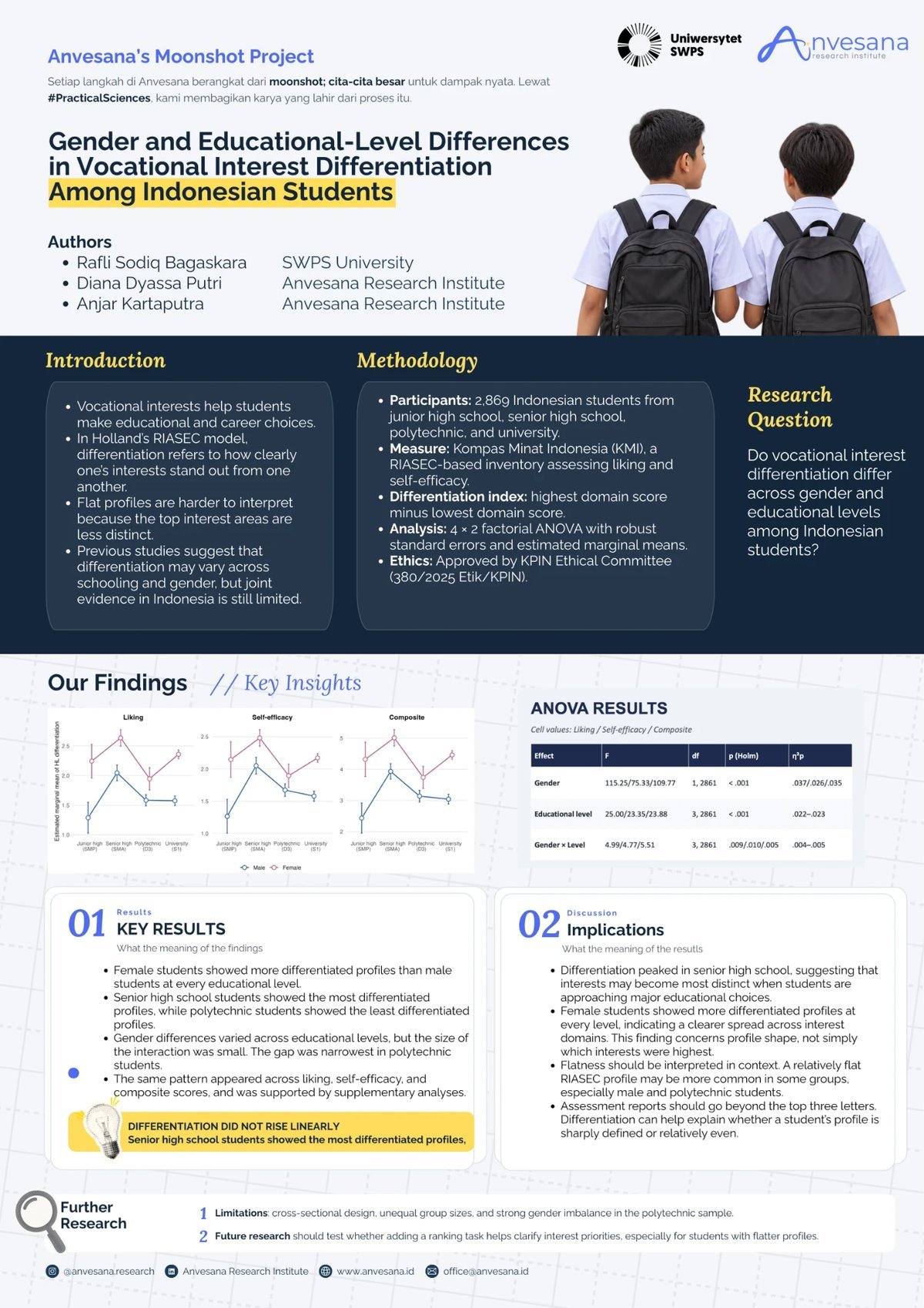
Anvesana's poster at ICPE 2026: Gender and Educational-Level Differences in Vocational Interest Differentiation Among Indonesian Students (opens the full-size poster in a new tab)

Award · 15 October 2026

Best poster at ICPE 2026.

Anvesana's poster on the differentiation of vocational interests among Indonesian students received the Best Poster award at The 5th International Conference on Psychology and Education, Faculty of Psychology, Universitas Negeri Surabaya.

Gender and Educational-Level Differences in Vocational Interest Differentiation Among Indonesian Students

Rafli Sodiq Bagaskara, Diana Dyassa Putri, Anjar Kartaputra

Among 2,869 students from junior high school to university who completed Kompas Minat Indonesia:

  • Female students' interest profiles are more differentiated at every level of education.
  • Differentiation is highest in senior high school and lowest in polytechnics; it does not rise in a straight line with level of education.
  • The gap between male and female students is narrowest in polytechnics.

Stage 3 Publications & scientific forums

Research that gets read.
Ideas that get discussed.

Anvesana's journal articles, proceedings, and scientific presentations, along with its researchers' work, linked straight to the source.

Faculty of Psychology · Universitas Negeri SurabayaICPE

The 5th International Conference on Psychology and Education 2026

Best Poster15 October 2026 · Online
International forum

Best Poster
at ICPE 2026.

Gender and Educational-Level Differences in Vocational Interest Differentiation Among Indonesian Students. How clearly students' interests take shape at each level of education, presented by Rafli Sodiq Bagaskara.

Best Poster
2,869
school and university students
4 levels
junior high, senior high, polytechnic, university
RIASEC
measured with Kompas Minat Indonesia

A trail of knowledge

Browse the scientific works.

Affiliations follow each publication. Work by researchers under other affiliations is labeled as in the original source.

6 works found · Newest first

ConferenceBest Poster

The 5th ICPE 2026 · Faculty of Psychology, Universitas Negeri Surabaya (online)

Gender and Educational-Level Differences in Vocational Interest Differentiation Among Indonesian Students (opens the source in a new tab)

Rafli Sodiq Bagaskara, Diana Dyassa Putri, Anjar Kartaputra

How clearly formed are students' interests at each level of education? Among 2,869 school and university students who completed Kompas Minat Indonesia, interest differentiation was highest in senior high school and lowest in polytechnics, and women's profiles were more differentiated at every level. The poster was selected as Best Poster at ICPE 2026.

Anvesana Research Institute · SWPS University

The abstract is published in the ICPE 2026 program book. No proceedings paper or DOI was listed in the sources checked.

ConferencePresented

The 4th ICoP 2026 · Faculty of Psychology, Universitas Muria Kudus (hybrid)

A Multitrait-Multimethod Validation of the Next Chapter Game-Based Assessment as a Measure of General Cognitive Ability (opens the source in a new tab)

Junialdi Dwijaputra, Anjar Kartaputra, Anisa Rima Fadhilah, Nadim Alfan Assa, Muhammad Hafiz Sabiqulhaq, Rafli Sodiq Bagaskara

Can games measure cognitive ability? Fifty-one adults completed the seven Next Chapter games and Indeks Kognitif Nusantara Umum. The combined game score tracked general cognitive ability and distinguished high from low scores fairly accurately, but the data do not yet support reading each game as a measure of a specific ability.

Anvesana Research Institute · Institut Teknologi Sepuluh Nopember · SWPS University · University of Limerick

The abstract is published in the ICoP 2026 program book. This is an early study with a small sample; the full manuscript has not been submitted to a journal, and the proceedings publication announcement is scheduled for 16 November 2026.

ConferencePresented

TEMILNAS I ANI 2026 · Universitas Gadjah Mada, Yogyakarta

Efisiensi Performa Kognitif NES pada Kondisi Berbatas dan Tanpa Batas Waktu (opens the source in a new tab)

Tim Anvesana Research Institute

The Net Efficiency Score (NES) research was brought to a neuropsychology forum to discuss cognitive performance efficiency under two working-time conditions.

Anvesana Research Institute

The available links hold the agenda and documentation of the presentation. No proceedings paper or DOI was listed in the sources checked.

ProceedingsConference abstract published

IOCHI 2026 · MDPI / Sciforum

Global Trends in Cognitive Measurement: A Bibliometric Analysis (opens the source in a new tab)

Rafli Sodiq Bagaskara, Anisa Rima Fadhilah, Sani Rahma Azzahra

A bibliometric study mapping the development of cognitive measurement research, its research themes, and the distribution of scientific contributions over the period 2011–2025.

Anvesana Research Institute & Universitas Gadjah Mada

The Sciforum page provides the abstract and citation information; the PDF material is also available through ResearchGate. The conference took place on 25–26 March 2026; no DOI has been listed.

ProceedingsPublished

SHS Web of Conferences · 224, 04006 · ICAP-H 2025, Universitas Muhammadiyah Malang

A comparative analysis of 2-option and 3-option response formats for computerized work aptitude test (opens the source in a new tab)

Rafli Sodiq Bagaskara, Anjar Kartaputra

A comparison of two- and three-option response formats in a computer-based work aptitude test, part of the measurement design research for Focusync.

Anvesana Research Institute

DOI: 10.1051/shsconf/202522404006 (new tab)
JournalPublished

Jurnal Psikologi · 51(3), 272–296

Exploring Vocational Interest Measurement Instruments in Indonesia: Insights from a Scoping Review (opens the source in a new tab)

Rafli Sodiq Bagaskara, Hanif Firdaus Gitya Iman Nurochim, Hadina Pramesti Diba Susilowati, Nisrina Nurika Agustin

A scoping review of 17 articles on vocational interest instruments in Indonesia, mapping their theoretical foundations and psychometric evidence as well as the need for further research.

Researchers' work · Universitas Negeri Yogyakarta, Universitas Airlangga, and University at Albany, SUNY

DOI: 10.22146/jpsi.101309 (new tab)

Author affiliations follow the published article; this work does not list an affiliation with Anvesana Research Institute.

Metadata checked 1 October 2026. This list is a selection of works that have been traced; links open the source page in a new tab.