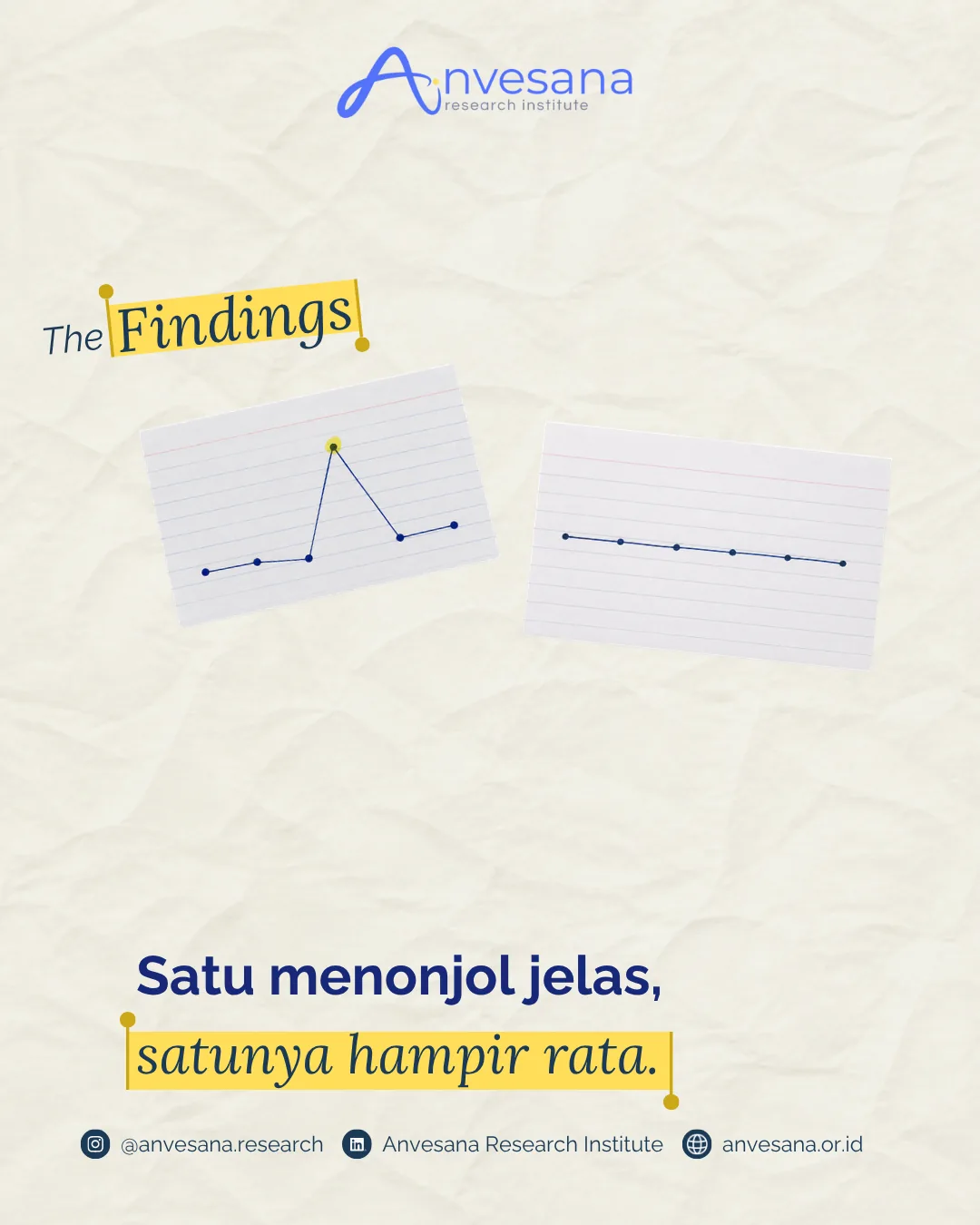
Two students can both come out as the Social type, yet the shapes of their interest profiles differ. An Anvesana study of 2,869 students looked at how they differ by gender and level of education.
Two test results, one shared letter
Imagine two eleventh-grade students receiving their interest test results. Both get the same label: their top interest is Social. At a glance, the advice for them could be the same too, for instance a major that involves working with people a lot.
But look at the graphs. For the first student, the Social score towers far above the other interests. For the second, Social is indeed the highest score, but only by a narrow margin, and all six interests sit almost level. The top letter is the same; the shape of the profile is very different.
In Holland's RIASEC model, interests fall into six types: Realistic, Investigative, Artistic, Social, Enterprising, and Conventional. How clearly a person's top interest stands out from the others is called vocational interest differentiation. A sharply peaked profile means high differentiation. A nearly level profile, which practitioners often call a "flat" profile, means low differentiation.
Starting from flat profiles in the counseling room
Flat profiles are nothing rare for interest assessment practitioners, and they leave a practical problem. Much of the advice on majors and occupations rests on the three highest interest codes. When the gaps between scores are narrow, that top-three order shifts easily and is hard to rely on. Earlier research hinted that differentiation may differ by school level and gender, but evidence looking at both at once among Indonesian students was still limited.
The Anvesana Research Institute research team pursued that question among 2,869 school and university students from four levels of education: junior high school, senior high school, polytechnic, and university. Their interests were measured with Kompas Minat Indonesia (KMI), a RIASEC-based interest inventory that records two things for every interest type: how much a person likes its activities (liking) and how confident they are that they can do them (self-efficacy).
Differentiation was computed in a simple way: the highest interest score minus the lowest. The larger the difference, the more peaked the profile. Differences between groups were then tested with factorial analysis of variance, a statistical technique that looks at the roles of gender, level of education, and their combination at the same time, with a Holm correction so that the number of comparisons does not produce chance findings. The study received ethical approval and was presented at ICPE 2026, where the poster won the Best Poster award (Bagaskara et al., 2026).
Female students' profiles are more peaked at every level
The most consistent finding concerns gender. At all four levels, female students' interest profiles were more differentiated than male students'. The pattern appeared in the liking scores, the self-efficacy scores, and the two combined (Bagaskara et al., 2026).
This finding needs to be read with care. What is being compared is the shape of the profile, not which interest is highest, let alone ability. A peaked profile does not mean better, and a flat profile does not mean the student is confused or less mature. Nor does the study claim that female students are more capable or more ready to choose a career.
The size of the difference is also small. The effect size for gender (η²p) ranged from .026 to .037. Roughly speaking, gender is associated with only about 3 percent of the variation in differentiation scores between students; most of the difference is associated with other things. In practice, many male students have sharp profiles and many female students have flat ones. A group pattern cannot be used to guess one person's profile.
Sharpest in senior high school
The team initially expected differentiation to rise with level of education: the higher the schooling, the clearer the interests. The data did not support that expectation. The most differentiated profiles were found among senior high school students, while polytechnic students showed the flattest profiles. Differentiation does not rise in a straight line with level of education (Bagaskara et al., 2026). This effect of level is also small (η²p .022–.023), roughly 2 percent of the variation.
Why senior high school? One possibility: in senior high school, the choice of a university major is right ahead. Students are actively finding out what they like and dislike, so their interests look sharpest. The team also suspects that once they enter university and the pressure to choose eases, profiles may flatten again. Both remain conjectures. Because every student was measured only once, this study cannot yet show how a person's interests change from junior high school to university.
There was also a finding about the combination of gender and level. The gap between female and male students was narrowest at the polytechnic level. This combined effect, however, is very small (η²p .004–.005, below 1 percent of the variation), and the polytechnic sample was highly unbalanced between men and women, so this pattern needs to be read with care.
To the team, this picture suggests that clarity of interest has more to do with the situation and context a student is facing than with simply growing with age or level of education.
Read the shape of the profile; don't stop at the top three letters
For school guidance teachers, counselors, and educational psychologists, the top three codes remain important information. But their weight depends on how far those codes stand out from the rest. On a peaked profile, the top three letters are strong enough as a starting point for a conversation about majors. On a flat profile, that order can change on the strength of one or two answers.
A flat profile is best treated as material for a conversation, not a conclusion. Invite the student to talk about the activities they truly enjoy, the experiences that made them feel capable, and other considerations beyond the test. Scaled answer formats, such as options from "strongly dislike" to "strongly like," also allow several interest types to score nearly the same or even tie, and this can contribute to a profile looking flat. Interest assessment reports are therefore more helpful when they show not only three letters but also how sharp the peak is.
For parents and students, a flat profile is not a sign that something is wrong. Interests may still be moving, especially when experience in trying out different fields is still limited. One reflection emerged from the team's discussion: career exploration may need to begin as early as junior high school, so that students do not first meet their interests when they have to choose a track in senior high school. This reflection still needs to be tested, but it is in line with the finding that interests are sharpest when a decision is near.
Limits of the findings and next steps
There are three limitations to keep in mind. First, the design is cross-sectional: every student was measured once, so differences between levels are differences between groups, not changes within the same people. Second, the number of participants in each group was unequal. Third, the polytechnic sample was highly unbalanced by gender, so conclusions about this group are the most limited (Bagaskara et al., 2026).
Several research directions are being considered. A longitudinal study following the same students over time is needed to answer whether interests really sharpen as the choice of a major approaches. The team also wants to test whether a task of ranking interests helps clarify priorities, especially for students with flat profiles. Other ideas under discussion are using the differentiation score as information about how common a person's profile is compared with their group, and a qualitative study of students with very peaked or very flat profiles. All of these are still research plans.
Ask one more thing: how sharp is the peak?
Interest test results are often summarized as three letters because it is practical. This study is a reminder that two students with the same letters can carry different stories. The next time you read an interest test result, as a guidance teacher, counselor, psychologist, parent, or the student yourself, ask one additional thing: how sharp is the peak? The answer helps decide whether the next conversation is about choosing a major, or about getting to know one's interests more deeply.
We are open to discussion with schools, guidance teachers, universities, and researchers who want to develop career interest research together.
References
- Bagaskara, R. S., Putri, D. D., & Kartaputra, A. (2026). Gender and educational-level differences in vocational interest differentiation among Indonesian students [Poster, Best Poster]. The 5th International Conference on Psychology and Education (ICPE) 2026, Universitas Negeri Surabaya.
Continue the conversation.
Have a question from practice that relates to this article? Tell us about it.
Send a message